Reliability of projections
Since before the First World War, it has been possible to predict with considerable precision where an artillery shell will land, based on factors such as projectile weight, ballistic coefficient, elevation, and firing angle. With the aid of modern technology, this precision has only improved. The underlying principle is that, in such systems, inputs and variables are known and largely measurable—making the outcome reliably predictable.
No such predictability exists when it comes to small and mid-sized businesses. Forecasting precise financial outcomes five to seven years into the future is not only inherently speculative—it is often misleading. Any party asserting detailed knowledge of every financial metric that far ahead should be met with healthy skepticism.
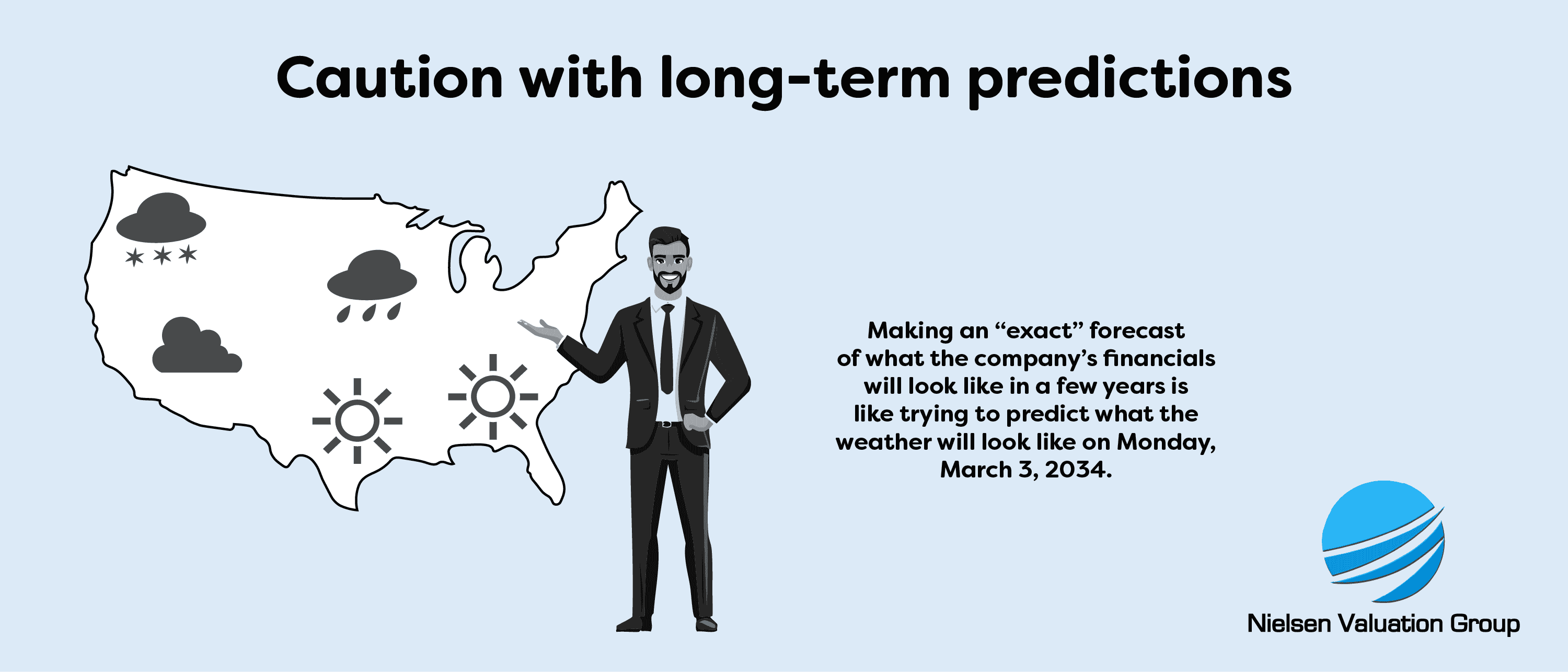
The gap between projection and outcome is often so large that the original assumptions appear less like analysis and more like fiction. Indeed, the predictive power of such models over a five to seven horizon is roughly on par with attempting to forecast the weather for a specific day seven years into the future.
Don’t Pay for a Yacht When You’re Buying a Raft
Some business sellers, valuators, and brokers claim that buyers should pay a higher purchase price today based on projections — such as the belief that the business could grow or improve. The justification typically centers on hypothetical future outcomes. These claims often reflect what could be done with the business — not what has been done, or what the buyer is actually acquiring today.
Revenue Ruling 59-60 cautions against this very type of speculative valuation. RR59-60 instructs appraisers to evaluate the business based on all relevant facts known or knowable as of the valuation date. It does not authorize assigning today’s value based on what someone hopes to achieve tomorrow.
This is analogous to a boat salesman trying to sell a small inflatable raft while calling it a yacht — on the grounds that the raft could become a yacht if the buyer adds an engine, fiberglass hull, radar system, and luxury interior. A credible dealer wouldn’t use that argument. The asking price would reflect what the boat is today — not what it might become if someone else builds it out.
Similarly, in valuation, buyers should not be asked to pay today for the business they are being told they can build. The value must reflect the results already achieved: the current net assets, current earning etc— not unexecuted growth or unmonetized potential. This valuation adheres strictly to that principle.

The Boat Is Seaworthy Today — Price It That Way
While forward-looking risk is always a factor, Revenue Ruling 59-60 makes clear that the valuation must reflect the facts as they exist at the time of the appraisal.
If a yacht is in excellent condition today — with clean hull, well-maintained engines, and no structural issues — its price should reflect its current state. The fact that all boats eventually rust or need repairs does not justify pricing a seaworthy yacht like one that’s already corroded and unusable.
Imagine a salesman standing between two boats — one visibly gleaming and another clearly neglected, rusted, and in disrepair. The boats are not priced the same, and rightly so. The value is determined by their condition today — not based on the projections of what might happen in the future.
In the same way, a business should also be judged and appraised for what it has actually demonstrated, not based on projections of what might happen in the future.
This valuation respects that principle and in doing so, it remains consistent with both the letter and spirit of Revenue Ruling 59-60.
Financing unproven claims

An individual applying for a mortgage must prove their income—they cannot just make unverified claims about future income. A bank would consider such a person unqualified and a waste of time. Similarly, business brokers generally view sellers who expect to be paid in cash for claimed but unproven future potential as time-wasters.
Three Types of Forecasts
Slightly simplified, forecasts can be divided into three types. None of them is without problems, but they are problematic in different ways, in descending order:
Type 1: The Forecast in the Case Study
Forecast-based valuations are relatively common. The method may work as an academic exercise, but it rarely reflects how companies are valued in actual transactions.
Type 2: Predefined Rule-of-Thumb Formulas
The second type is based on standardized formulas often used by business appraisers who take shortcuts. The results may be more reasonable than in the example above, but these formulas do not sufficiently account for the specific circumstances of the individual company and therefore still present a misleading picture.
Type 3: Continued Historical Growth
If reported earnings—that is, the profit on which the company has actually paid taxes—have grown consistently and without interruption for at least four to five years, it may be reasonable to assume that the growth will continue.
A Realistic Alternative: Weighted Historical Earnings
If the company has not experienced consistent and uninterrupted earnings growth for at least four to five years, a weighted average of historical earnings will often come closer to how value is determined in actual transactions. The weighting must be done with great care, because it has a significant impact on the representative earnings figure and, consequently, on the valuation.
Claims Do Not Create Value
Anyone who builds a valuation on claims rather than demonstrated profitability is, in practice, the valuation industry’s equivalent of the stereotypical used-car salesman. Even the most favorable figures suggest that roughly 80 percent of sales processes that are initiated never result in a completed transaction.
Business owners and advisors who instead focus on creating and documenting actual profitability are in a much stronger position to achieve a favorable outcome. Unsupported claims have no value in a transaction. Unfortunately, many business owners discover this only after they have paid the engagement fee—a fee that often represents the majority of the seller’s advisor’s revenue when the engagement never results in a completed deal.

Christoffer Nielsen
Cell phone: (737) 232-0838
[email protected]
LinkedIn
Nielsen Valuation Group LLC
- Number of business valuations completed: 250+
- Number of valuations for disputes/divorces: 70+
- Largest client (revenue): $87 million
- Majority of customers: $2 million to $50 million in revenue
- Largest client (valuation): $155 million
Want to go with a cheaper option or even do the valuation yourself?
Nothing is stopping you, but...

You may lose the lawsuit, due to the valuation failing to be waterproof.

You may never settle the conflict, hurting the relationship with your counterpart.